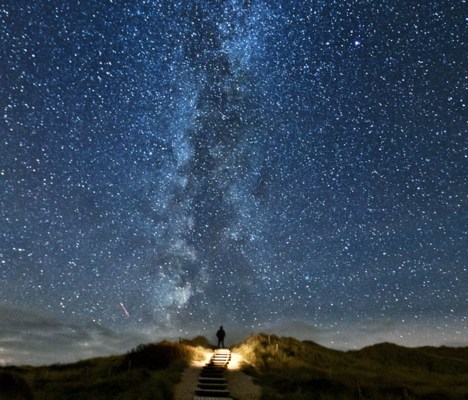

The Destiny of Earthseed is to take root among the stars. This is the third tenet of Earthseed.
The Destiny of Earthseed
Is to take root among the stars.
It is to live and to thrive
On new earths.
It is to become new beings
And to consider new questions.
It is to leap into the heavens
Again and again.
It is to explore the vastness
Of heaven.
It is to explore the vastness
Of ourselves.
The Destiny of Earthseed is to take root among the stars. Thatʼs the ultimate Earthseed aim, and the ultimate human change short of death. Itʼs a destiny weʼd better pursue if we hope to be anything other than smooth-skinned dinosaurs—here today, gone tomorrow, our bones mixed with the bones and ashes of our cities.
It wonʼt be possible for a long time. Now is a time for building foundations—Earthseed communities—focused on the Destiny. After all, heaven really exists, but you donʼt have to die to reach it.
The Destiny is important for the lessons it forces us to learn while we’re here on Earth, for the people it encourages us to become. It is important for the unity and purpose that it gives us here on Earth. And in the future, it offers us a kind of species adulthood and species immortality when we scatter to the stars.
Why do some people find it so easy to believe we go to heaven after we die, but so hard to believe we can go into the heavens while we’re alive? Following the Earthseed Destiny is difficult. Massively difficult. That’s the challenge. But if we want to do it, someday we’ll do it. It’s not impossible
The Destiny helps us to understand what we can be, what we can do. It gives us a focus, a goal, something big enough, complex enough, difficult enough, and in the end, radical enough to make us become more than we ever have been. We keep falling into the same ditches. We learn more and more about the physical universe, more about our own bodies, more technology, but somehow, down through history, we go on building empires of one kind or another, then destroying them in one way or another. We go on having stupid wars that we justify and get passionate about, but in the end, all they do is kill huge numbers of people, maim others, impoverish still more, spread disease and hunger, and set the stage for the next war. And when we look at all of that in history, we just shrug our shoulders and say, “Well, that’s the way things are. That’s the way things always have been.”
But we can do something no other animal species has ever had the option to do. We can choose: We can go on buildings and destroying until we either destroy ourselves or destroy the ability of our world to sustain us. Or we can make something more of ourselves. We can grow up. We can leave the nest. We can fulfill the Destiny, make homes for ourselves among the stars, and become some combination of what we want to become and whatever our new environments challenge us to become. Our new worlds will remake us as we remake them.
We are Earthseed.
We are flesh—self aware, questing, problem-solving flesh.
We are that aspect of Earthlife best able to shape God knowingly.
We are Earthlife maturing,
Earthlife preparing to fall away from the parent world.
We are Earthlife preparing to take root in new ground,
Earthlife fulfilling its purpose, its promise, its Destiny.
∞ = Δ
The text above is excerpted and adapted from Octavia Butler’s Parable of the Sower (1993) and Parable of the Talents (1998).
One of the great things about Butler’s parable series is its self-critique. Parable of the Sower was written from the perspective of its protagonist Olamina. But Parable of the Talents was written from the perspective of Olamina’s daughter, who is critical of her mother and her vision. And the unfinished and unpublished Parable of the Trickster novel was intended as a critique of the Destiny.
The trickster in the title was appropriate, since it turns out that the Destiny is a kind of trick. There were many drafts of this story among Butler’s papers, but they all focus on an extrasolar colony of Earthseed followers who have settled on a planet they call “Bow”. The planet is gray and dank, and the colonists are miserable and wish they’d never left Earth. In the different drafts, disasters of various kinds ensue, some environmental, like disease, and others of human making, like dictatorships and religious purges. As Butler explained in an interview: “The real problem [the colonists face] is dealing with themselves”. Gerry Canavan elaborates on this in his review of Butler’s unfinished work:
“So of course we discover that achieving Earthseed’s Destiny, despite Lauren Olamina’s dreams, hasn’t solved the problem of the human at all, only extended our confrontation with the very difficult problems that drove its development in the first place—only removed them to some other world where they can take some other form. The Destiny was essentially a hyperbolic delaying tactic, a strategy of avoidance; even achieved, it’s worthless in its own terms. The fundamental problem is still how to make a better world with such bad building blocks as human beings.”
— GERRY CANAVAN, ‘“THERE’S NOTHING NEW UNDER THE SUN, BUT THERE ARE NEW SUNS”: RECOVERING OCTAVIA E. BUTLER’S LOST PARABLES’
Though there’s no indication of it in the first two books, Butler’s notes for Trickster reveal that she was aware of the problem with the Destiny and the dilemma of human nature. She wrote: “We can’t afford to assume that another living world with its own biota and its own eons of existence will be able to tolerate our nonsense…taking, and putting back nothing—or putting back poisonous waste.”
 Earthseed
3 thoughts on “The Destiny of Earthseed is to take root among the stars.”
Comments are closed.